Showing posts with label business intelligence. Show all posts

Monday, July 27, 2020

BI & Analytics Business Cases in the Time of COVID-19


ASUG’S Undercover CIO notes in Making the Right IT Investments in Uncertain Times that the COVID-19 pandemic has caused a shift in how CIOs determine the course of IT investments, citing the ASUG Pulse Check:

47% of respondents said their organizations were not canceling any planned IT initiatives, while nearly half (45%) shared that they are postponing a few planned initiatives. The top reason respondents provided to explain these cancellations was that these initiatives were not considered “core” projects.

Uncertainty has this effect, and everyone wants to manage more efficiently and still be positioned to hit the ground running when that uncertainty is resolved, which is why streamlining is such a common theme:

...you need to look at automation, as well as doing less with physical assets and more with intelligent assets. Your business case for any project right now should be about streamlining.

In BI & Analytics, as elsewhere, streamlining means doing more with less, while ensuring your organization is ready to meet an uncertain future.

Streamlining through automation is a consistent theme throughout APOS Well Managed BI & Analytics solutions. They let you take control of your deployments, helping you to manage effectively in the present and prepare for what’s next.

Wednesday, March 27, 2013

Webinar: 5 Ways to Improve Healthcare BI & Outcomes

Join Us for this Important Webinar on Wednesday, April 10, 2013, at 10 am or 4 pm ET
If you work in healthcare Business Intelligence, you know that you inhabit one of the most rapidly evolving, complex, and data critical types of BI environment there is. You also know that the prognosis is for radically and rapidly increasing data governance requirements and information sharing.

BI is critical not just for the business outcomes of provider and payer organizations, but also for clinical outcomes as well. And the continuing development of Meaningful Use strategies and Healthcare Information Exchanges will make the future of healthcare BI platform management extremely challenging.

This webinar discusses how you can manage your SAP BusinessObjects platform to provide better business outcomes, and to complement your organization's electronic health record (EHR) efforts, and its quest for better compliance with local, national and international regulatory standards, and better clinical and healthcare outcomes.
Join us:

Tuesday, December 11, 2012

APOS Insight Lite - BusinessObjects System Metrics

Are you an SAP BusinessObjects platform manager or administrator being asked to do more with less? Do you need a clear inventory of the objects, schedules and instances in your deployment? Do you want to know which objects in your deployment are most frequently used? Most rarely used? Would the ability to analyze and compare report processing windows help you optimize your system?

APOS Insight Lite can help you deal with these questions and more.

APOS Insight Lite is a subset of the services found in the APOS Insight Advanced Solution, a full-featured system metrics, performance analytics, and system planning solution for SAP Business Objects.

Find out more about APOS Insight Lite BusinessObjects system metrics.

Friday, June 8, 2012

Facebook IPO: Data Rich, Information Poor, Analysis Absent?

Michael Rappa's analysis of the circumstances surrounding the Facebook IPO reveals just how easy it is for a large and seemingly bulletproof enterprise to fail miserably at Business Intelligence, Business Analytics, and Big Data:

Facebook has mountains of data on a scale few companies have ever seen before. Shouldn't it have unparalleled insights into its users and their value to advertisers? Reading the prospectus, I was surprised to see the IPO rested as heavily as it did on the weight of a single trend line ‑ growth in active users over time ‑ and not on data-driven insights into its user community. If Facebook is making good use of its data, it’s not evident to investors.

It seems to be a classic case of selling the sizzle rather than the steak, and the market figured it out pretty quickly, though not quickly enough to prevent a lot of people losing a lot of money. Has the dot-com bubblereally faded from our collective memory that quickly?

It's already hard to remember what we did before social media, but the question about social media, as with the dot-com ventures, has always been how to monetize its great wealth of community and data.

But the Facebook story is now also a Big Data story, because the information Facebook has about each of us is vast, and comes in many formats. It has volume and variety, two of the three defining qualities for Big Data.

The third defining quality for Big Data is velocity: It's not enough to analyze the available data; the analysis has to be as close to immediate as possible. If Big Data offers competitive advantage, it is in the velocity with which insight can be delivered and monetized.

Risk management, management by strategic objective, and public company governance find common cause in Big Data. Jill Dyché says as much in her Harvard Business Review article, "Data: One Antidote to Risky Behavior":

Savvy managers understand that weaving data-driven decisions into the fabric of corporate governance can obviate organizational infighting and drive progress. By establishing clear accountability measures, managers can determine whether and how corporate goals are being achieved, and hold people accountable for how they are achieving those goals. This motivates business people to rely less on hunches and more on hard data.

When we apply what we know, when we know it, to the realization of strategic objectives, we mitigate risk, and increase shareholder value. The attraction of managing by "gut feelings" has always been its immediacy. Providing the hard data to support or counter gut feelings with the same kind of immediacy is the Business Intelligence/Business Analytics/Big Data challenge.

Thursday, May 17, 2012

Redefining BI

In the March 2012 edition of IT in Europe, SearchDataManagement.co.UK's Brian McKenna presents a simplified definition of BI:

Business Intelligence is ripe for defamiliarisation as a term. For IT professionals, the temptation is to understand it to mean query and reporting tools from the BI megavendors. But for one of the finance professionals quoted in this issue of IT in Europe: Data Management & BI Edition, “business intelligence means trying to make money out of data.” [Emphasis added.]

I like this definition, because it takes us closer to first principles. It takes us back to strategic objectives.

When we get set in our ways, comfortable and complacent in the status quo, we start to mistake the practice for the objective. Why do we do things the way we do them? Because that's the way we've always done them.

But the imperative to optimize the top and bottom lines of an enterprise requires us to re-examine our practices on a continuous basis. Can the practice be improved to bring us closer to our strategic objectives? Can a practice be said to be a best practice if it is not connected somehow to the realization of a strategic objective?

As I said, I like the redefinition. However, I don't think it goes far enough. I'm in the Peter Drucker school of thought on this one. Drucker was suspicious of the profit motive as a primary business driver. The purpose of a business, according to Drucker, is to create a customer. By measuring the success of the company against the ongoing relationship with the customer, we create a business that is first and foremost sustainable, but also mutually profitable.

BI's potential contribution to the pursuit of strategic objectives is obvious but not inevitable. BI professionals need to take a progressive approach ‑ to look for ways to achieve strategic objectives through better utilization of the BI platform.

In an article dedicated to the centenary of Drucker's birth, Oliver Marks notes another Drucker maxim: "Knowledge has to be improved, challenged, and increased constantly, or it vanishes." For the BI professional, it's not just about improving knowledge, but about improving the way knowledge is stored, managed and disseminated.

Tuesday, March 6, 2012

From Legacy Headaches to BI ROI

I remember a time when the biggest debate in enterprise IT departments was whether to purchase "best-of-breed" solutions or integrated systems. Line-of-business managers leaned toward the rich functionality of the best-of-breed solutions, and executives and corporate directors were more interested in the wider and easier access to data provided by integrated systems. IT departments were caught in the middle, trying to please multiple masters.

These past battles come down to us as today's legacy applications. The average enterprise IT department may have dozens of software systems to maintain. But they also have to maintain the numerous platforms on which these software systems reside. And sometimes the demise of the platform overtakes the usefulness of the application.

It's a rare crisis that doesn't also present an opportunity to those who can see through the confusion. Many BI platform managers are in this position today. They have under their control a best-of-breed business intelligence solution that can access all enterprise data sources. The BI system is that formerlly elusive combination of best-of-breed solution and integrated system.

When the ROI of a legacy platform or solution is under review, the first question should be whether state-of-the-art systems such as your BI system can absorb the legacy function for increased BI ROI and reduced TCO.

Wednesday, January 4, 2012

Big Data Analytics Skills Shortage

A recent article at SearchBusinessAnalytics cited "raw and user-unfriendly technology" and lack of "skilled experts" in these technologies as the biggest challenges for large enterprises seeking the considerable benefits of big data analytics. As enterprises become more information driven, and business intelligence and analytics become critical to competitive advantage both strategically and operationally, there just aren't enough skilled personnel to handle the development of the needed predictive modeling and predictive analytics applications.

The greatest need is for more data scientists -- people who have post-graduate educations in statistical analysis. As demand grows, and supply remains relatively constant, individuals with these skills will command larger and larger portions of corporate business analytics budgets.

While this "crisis" seems worrisome, it is a problem that the average business intelligence platform manager would love to have. They would all like to be pushing the data analytics envelope to provide proactive and progressive solutions that meet or exceed their enterprises' information needs. Instead, these managers are dealing with smaller curative or preventive issues that won't go away, and which occupy altogether too much of their budget, and their resources' time.

The oldest (okay, maybe second oldest) service-type business proposition in the world goes something like this: If I can make (or save) you $50, will you pay me $5? In IT, such a proposition speaks to both return on investment (ROI) and total cost of ownership (TCO): you make back the money you invest in the service, and you save on the cost of operating the system.

That's the promise of APOS well managed BI solutions. You conserve the time of your resources, and you can move away from fixing and preventing problems, and toward providing progressive business intelligence solutions for your information consumers.

Wednesday, November 23, 2011

US Military Logistics, Well Managed BI


A recent notice published at FedBizOpps.gov declared that the US Department of the Air Force, Air Force Materiel Command (AFMC), has renewed its maintenance contract with APOS Systems for the APOS Administrator (InfoScheduler) solution.

The mission (PDF) of the Air Force Materiel Command:
We deliver war-winning expeditionary capabilities to the warfighter through development and transition of technology, professional acquisition management, exacting test and evaluation, and world-class sustainment of all Air Force weapon systems.

AFMC's management and delivery of information is mission critical in the extreme. Lives and national security are at stake, and it is gratifying for us to know that they use our solution to improve the efficiency of their BI platform and the timeliness of information delivery.

But this story is not just about doing the job well. AFMC's use of APOS Administrator also aligns with the Command's recent efforts to streamline their operations for greater efficiency, higher ROI, and lower costs.

As those of you who have been following the well managed BI saga know, APOS solutions are built to help business intelligence platform managers, administrators and technologists make more efficient use of their BI platform. Well managed BI is a quest to climb the capability maturity model (CMM) for BI platform management. The CMM has three levels:
  • If you are at the Curative level of the model, your are constantly reacting to system events and information consumer issues. You are in firefighting mode.
  •  If you are at the Preventive level, you are actively seeking out and correcting problems before they affect your information consumers.
  • If you are at the Progressive level, you are proactively seeking new opportunities to expand the use and ROI of your BI platform for the benefit of different business units.

The Air Force Materiel Command's commitment to the APOS Administrator solution validates our belief that well managed BI is a critical component in any organization's quest to fulfill its core mission.

Learn more about well managed BI. Download the Well Managed BI: Managing Your BI Platform for ROI white paper.

Friday, November 11, 2011

APOS on the Road - 2011

APOS had a very active year at conferences and tradeshows. If we weren’t attending conferences to keep up to date on SAP BusinessObjects, Teradata and Esri solutions, we were actively exhibiting at numerous tradeshows throughout the world.

To all of you who dropped by to see us at these conferences and tradeshows, we thank you. Without your feedback, we can't continue to be the leading provider of well managed BI solutions for SAP BusinessObjects. Our iPad giveaways were just a small token of that appreciation.

The APOS booth at the ASUG/SAP BusinessObjects conference was simply magical — literally. But don't take our word for it: watch this video of Danny Orleans in action.

We are already in the planning stages for next year's conference and tradeshow schedule, and are looking forward to seeing all our old friends and meeting new ones. In the mean time, you can keep in touch with us through our social media. To find out where we'll be next and arrange to meet with members of our team, please feel free to contact Jay Murdoch.

View APOS System's LinkedIn Company PageFollow APOS Systems on LinkedIn.

Thursday, October 20, 2011

APOS Well Managed BI CMM

Do you consider your BI platform well managed? How do you measure well managed? Is "well managed" something you can quantify?

The APOS BI CMM (capability maturity model) can help you come to terms with these questions and benchmark your BI deployment so you can quantify its progress toward well managed BI. The APOS BI CMM consists of three levels:
  • Curative - reactive activities, firefighting
  • Preventive - actively seeking out problems before they happen
  • Progressive - proactively seeking new opportunities to expand the use and ROI of your BI platform for the benefit of different business units
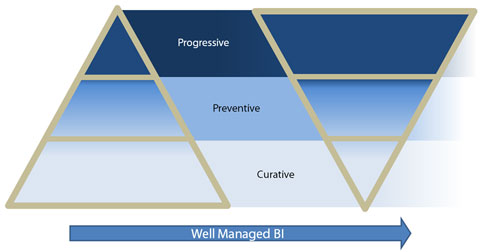
Think of your BI deployment as a pyramid divided amongst these three levels. The size of each division within the pyramid represents the proportion of your resources' time dedicated to those types of activities. While all BI deployments require each type of activity, your BI platform can be considered well managed if you progressively minimize the time your resources dedicate to curative and preventive activities and redeploy those resources to progressive activities.

The objective of well managed BI is to invert the pyramid:


The term "well managed" may be qualitative and subjective, rather than quantitative and objective, but what you can quantify is how much time your resources dedicate to their various tasks and responsibilities. By benchmarking these hours, you can chart your course toward progressive BI and judge the relative efficacy of each step you take.

To benchmark your BI maturity, look at your resources' timesheets. Make a list of the activities they report, and classify each according to whether it is curative, preventive, or progressive. (If you have a hard time with this part of the exercise, you might have to reconsider the way your resources report to you.) Record the time spent on each activity through a period of time long enough to cover your basic business cycles (e.g., monthly quarterly, annual).

As you implement well managed BI best practices and undertake progressive initiatives, you should notice a marked shift in the proportion of curative to preventive to progressive.

Wednesday, August 3, 2011

APOS COO Allan Pym Interviewed by SmartBrief

SmartBrief's Jesse Stanchak interviewing APOS Chief Operating Officer Allan Pym at the 2011 Esri Business Summit on the relationship between business intelligence and location intelligence:

Posted by Tom Woodhead at 8:00 am.
View APOS System's LinkedIn Company PageFollow APOS Systems on LinkedIn.

Wednesday, May 18, 2011

BI Publishing and the CFO

Linda Tucci of SearchCIO-Midmarket tells the story of a CFO taking the lead on business intelligence strategy. What drove the CFO to get involved? Was it quality of information? Was it the price of the solution? Total cost of ownership?

No. It was the fact that the company was going through reams of paper on a daily basis. Their staff were manually sorting, collating, troubleshooting and distributing reports. CFO Gary Petrangelo:

"The larger the size of the department, the bigger the report. Our mailing department could have 200 pages to page through if a discrepancy showed up in the bottom line," Petrangelo said... "To me it just seemed senseless, with all the technology we have. We should be able to generate that in electronic format," Petrangelo said.

What drove the CFO to get involved was the company's outdated and unwieldy process of generating, distributing and accessing business intelligence -- in a word: Publishing. The publishing capabilities of their legacy BI system were not scalable and extensible enough to meet their growing needs.

This anecdotal evidence agrees with our experience selling the APOS Publisher solution: the growing demands on the BI system, the complexities of those demands, and the migration of line-of-business functions to the BI platform call for an end-to-end, integrated, scalable and extensible BI publishing solution.

View APOS System's LinkedIn Company PageFollow APOS Systems on LinkedIn.

Monday, May 9, 2011

Beyond Bursting: the Future of BI Publishing

Publishing has some very specific connotations in the business intelligence world. To some, BI publishing is just report printing, but this description does not do justice to the many subtleties and complexities of BI publishing. As BI becomes more pervasive within organizations, the needs of information consumers increase and grow more complex, and so do the information delivery requirements.

BI publishing is more than just bursting now. It has become a much larger topic within today's enterprise. An end-to-end BI publishing solution should not only meet today's information requirements, but also lay the groundwork for the future of enterprise information generation, delivery, and secure access.

Let's look at BI publishing at the conceptual level. The objective of an end-to-end BI publishing solution is to get the right content to the right information consumer, at the right time, in the right format, and with the right level of security. The solution has to generate the content, distribute it, and provide (secure) access to it. And to ensure that all of these things happen according to plan, the solution must have an administrative layer that assures delivery and provides remedial capabilities.

A BI publishing solution that does all of these things well should be of interest to a variety of people within an enterprise:
  • BI administrators need to know that tasks have executed as scheduled, and they need to be able to validate reception of documents by information consumers. But knowing is not enough: they also need clear remedial courses of action to administer publishing processes proactively.
  • BI Platform managers need a BI publishing solution that is both scalable and extensible. Scalable, because they know that publishing needs will continue to grow as the demand for BI becomes more pervasive throughout the organization. Extensible, because line-of-business managers will continue to ask them for more enterprise publishing functionality. Knowing they have a robust BI publishing system gives platform managers the confidence they need to offer new enterprise publishing solutions.
  • Line-of-business managers need to optimize the flow of information within their business units and look for new ways to create competitive advantage. An end-to-end BI publishing solution goes beyond the generation and delivery of internal documents. As the use of BI publishing becomes more customer-facing, it becomes a key line-of-business tool, and the more line-of-business managers get from a BI publishing solution, the more they will demand.
  • CIOs and other C-level executives are looking for cost-effective ways to modernize legacy information systems. Many internal and customer-facing document generation and delivery applications reside on aging IT infrastructure. C-level executives are looking to leverage their BI investment to assume many of these legacy functions.
Have you missed an important webinar? Download recent webinars here.

Friday, March 25, 2011

Business Intelligence Goes "Mainstream" - Again

Cindi Howson says business intelligence went mainstream at info360 this week, but the title of her article is a bit misleading. I don't think she's saying that BI, which was already a US$3.6 billion industry 10 years ago, has suddenly become a viable industry. What she is really saying is that BI is now regarded as mainstream by the content, knowledge and records management professionals who organize and populate info360.

To those professionals I say: Welcome to the party.

The four topics that Howson identifies as subjects of presentations certainly do represent some of the biggest challenges and most exciting opportunities in the BI world:
  • Pervasive BI - getting the appropriate BI to all of the places in the organization where it will make a difference.
  • Mobile BI - get the information you need when and where you need it.
  • BI in the Cloud - addressing budgetary, resource, and scalability issues with software / platform / infrastructure as a service.
  • Social media BI - making BI a two-way conversation, and turning information consumers into information conduits

These topics (plus the notably absent topic of location intelligence) are the BI sizzle. We'll know these content, knowledge and records management professionals are serious about BI when they start spending their time discussing the far less flashy, but very pragmatic, integration issues - how to make business intelligence available to content management workflows.

View APOS System's LinkedIn Company PageFollow APOS Systems on LinkedIn

Monday, March 14, 2011

What Is Well Managed BI?

The whole point to implementing a business intelligence system is to improve operational efficiencies within your organization by delivering timely, accurate and relevant information to all stakeholders and decision makers. BI systems extract the most relevant information from your mission-critical systems and deliver it as actionable information to the people who need it.

You use business BI to judge the health of your enterprise, and to decide on appropriate courses of action. Your BI system monitors your Enterprise solutions, but how do you monitor your BI system to ensure the information being delivered is timely and accurate?

Well managed BI:

  • Ensures that you have the Insight into your system to know that it is working within established parameters;
  • Notifies an Administrator when the system is not functioning within those parameters, and provides the means for quick and easy remedial action;
  • Enables Pervasive Distribution of personalized reports across the Enterprise; 
  • Uses data visualization technology such as Location Intelligence to gain greater speed to insight; and
  • Makes regulatory compliance easy through Storage capabilities that archive documents securely and enable selective restore. 

These are some of the subjects I hope to discuss on this blog.

View APOS System's LinkedIn Company PageFollow APOS Systems on LinkedIn