APOS had a very active year at conferences and tradeshows. If we weren’t attending conferences to keep up to date on SAP BusinessObjects, Teradata and Esri solutions, we were actively exhibiting at numerous tradeshows throughout the world.
To all of you who dropped by to see us at these conferences and tradeshows, we thank you. Without your feedback, we can't continue to be the leading provider of well managed BI solutions for SAP BusinessObjects. Our iPad giveaways were just a small token of that appreciation.
The APOS booth at the ASUG/SAP BusinessObjects conference was simply magical — literally. But don't take our word for it: watch this video of Danny Orleans in action.
We are already in the planning stages for next year's conference and tradeshow schedule, and are looking forward to seeing all our old friends and meeting new ones. In the mean time, you can keep in touch with us through our social media. To find out where we'll be next and arrange to meet with members of our team, please feel free to contact Jay Murdoch.

You implement BI to optimize operational efficiency. What do you do to optimize BI efficiency?

Friday, November 11, 2011
APOS on the Road - 2011


Monday, October 24, 2011
Webinar: a Complete BI Publishing Solution
Webinar: Execute tightly controlled document production, publishing and distribution workflows with APOS Publisher.
Tuesday, October 25, 2011, 10 a.m. / 4 p.m. EDT.
If your SAP BusinessObjects deployment is well managed, it presents a single, consistent view of your corporate data, regardless of the number of datasources it joins. If this is the case, then your BI platform should also be your primary publishing platform for enterprise information.
But using your BI platform in this way may require you to overcome some major challenges, including:
For such organizations, APOS Publisher is a complete SAP BusinessObjects publishing solution, including robust bursting management, post-processing distribution service, report package management, and assured delivery to extend SAP BusinessObjects' capabilities.
APOS Publisher achieves advanced SAP BusinessObjects publishing through:
 Follow APOS Systems on LinkedIn.
Tuesday, October 25, 2011, 10 a.m. / 4 p.m. EDT.
If your SAP BusinessObjects deployment is well managed, it presents a single, consistent view of your corporate data, regardless of the number of datasources it joins. If this is the case, then your BI platform should also be your primary publishing platform for enterprise information.
But using your BI platform in this way may require you to overcome some major challenges, including:
- The growing volume, variety and complexity of enterprise document publishing
- Migration of legacy system functions to the BI system
- The need to monitor mission-critical processes closely, and manage proactively
- The need for flexibility and agility to address new line-of-business requirements
For such organizations, APOS Publisher is a complete SAP BusinessObjects publishing solution, including robust bursting management, post-processing distribution service, report package management, and assured delivery to extend SAP BusinessObjects' capabilities.
APOS Publisher achieves advanced SAP BusinessObjects publishing through:
- An advanced bursting engine
- Automated document production
- Workflow monitoring, alerts and auditing
- Interactive process control
- Assured delivery, auto recovery, & partial burst reruns
- Enhanced distribution, encryption & integration
Follow APOS Systems on LinkedIn.Thursday, October 20, 2011
APOS Well Managed BI CMM
Do you consider your
BI platform well managed? How do you measure well managed? Is "well
managed" something you can quantify?
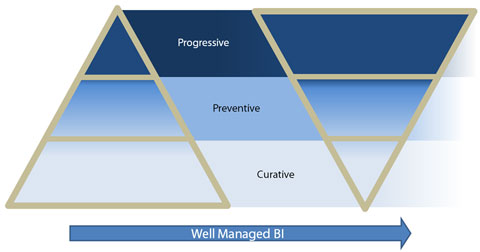
The APOS BI CMM (capability maturity model) can help you come to terms with these questions and benchmark your BI deployment so you can quantify its progress toward well managed BI. The APOS BI CMM consists of three levels:
The APOS BI CMM (capability maturity model) can help you come to terms with these questions and benchmark your BI deployment so you can quantify its progress toward well managed BI. The APOS BI CMM consists of three levels:
- Curative - reactive activities, firefighting
- Preventive - actively seeking out problems before they happen
- Progressive - proactively seeking new opportunities to expand the use and ROI of your BI platform for the benefit of different business units
The objective of well managed BI is to invert the pyramid:
The term "well
managed" may be qualitative and subjective, rather than quantitative and
objective, but what you can quantify is how much time your resources dedicate
to their various tasks and responsibilities. By benchmarking these hours, you
can chart your course toward progressive BI and judge the relative efficacy of
each step you take.
To benchmark your BI maturity, look at your resources' timesheets. Make a list of the activities they report, and classify each according to whether it is curative, preventive, or progressive. (If you have a hard time with this part of the exercise, you might have to reconsider the way your resources report to you.) Record the time spent on each activity through a period of time long enough to cover your basic business cycles (e.g., monthly quarterly, annual).
As you implement well managed BI best practices and undertake progressive initiatives, you should notice a marked shift in the proportion of curative to preventive to progressive.
Tuesday, October 4, 2011
Escape Velocity & Well Managed BI
Geoffrey A. Moore's most recent book, Escape Velocity: Free Your Company's Future from the Pull of the Past, is primarily about how to position a company to take best advanatage of the external and internal forces that bear on its current and future value and viability. It's a good book -- one that every product manager in a high-tech company should read, but what caught my attention on first read-through was an almost off-hand reference to the leadership / management opposition:
The leadership vs. management debate is important for BI platform management as well.
APOS delivers well managed BI, but we also promote what we call progressive BI. The most succinct way of summarizing the difference between the two is that it is essentially the difference between management and leadership.
Leadership vs. Management
Well Managed BI vs. Progressive BI
Gravity, Inertia and Resource
Allocation
Newton taught us several centuries ago in his first law of motion, the one that covers inertia, that an object at rest tends to stay at rest and an object in motion tends to continue in the direction in which it is currently moving. The same goes for resource allocation.
And so the theme is set: we need to break free from the past to embrace the future. Since budgets are expressions of priorities, it is in resource allocation that this expression will be seen.
The Journey from Well Managed BI to
Progressive BI
Asymmetrical bets [sacrificing smaller short-term gains for a larger mid-term return] are the foundation for creating company power, putting in high relief the distinction between leadership and management. Managers resist asymmetrical bets for a host of good reasons: They are both inequitable and socially unpopular. They are hard for shared services organizations to support. They entail taking high-visibility (and potentially career-limiting) risks. They run roughshod over personal loyalties. They stretch the organization far beyond the limits of its comfort zone. They are departures from the norm.
Leaders acknowledge all of the above, but they still persist in making asymmetrical bets, also for a host of good reasons: They want the power to win. They are more externally than internally focused. They want to adapt the company to the market, not the other way around. They want to make a difference. They want to make sure that sacrifices -- which are inevitable in any strategy -- are made in a worthwhile cause.Moore advocates a lead-first, manage-second philosophy. That is, you need to reference the activities inside the company against external realities and allocate your resources accordingly. The alternative is wishful thinking -- hoping that your internal priorities will somehow, magically, match up with external demand.
The leadership vs. management debate is important for BI platform management as well.
APOS delivers well managed BI, but we also promote what we call progressive BI. The most succinct way of summarizing the difference between the two is that it is essentially the difference between management and leadership.
Leadership vs. Management
Much has been written
about the difference between leadership and management, and we often see the
two painted as irreconcilable opposites. The world of business, with all its
shades of gray, really has no place for such absolute oppositions. Leaders have
to manage, and managers have to lead, but the two activities can trigger some
real cognitive dissonance.
The cognitive dissonance arises mostly in relation to the idea of risk. Our management side is trained to be risk-averse. Steady as she goes; don't rock the boat; the status quo has been good to us. However, to lead, we need to embrace risk as the necessary travelling companion of opportunity, and to understand that the benefits of the status quo won't last forever.
According to Moore, management views the world from the inside out, while leadership views the world from the outside in. That is, our management side wants to fit the exterior reality to our operating plan, while our leadership side wants to mold the operating plan to fit the exterior reality.
Well Managed BI vs. Progressive BI
How does this all
relate to APOS well managed BI solutions? Well, as I said earlier, the
difference between well managed BI and progressive BI is the difference between
management and leadership.
APOS delivers well
managed BI. We do so through solutions that simplify, automate, enhance and
extend the administration and management of your BI platform. We look at the
practice of BI within an organization in the light of a capability maturity
model, which has three levels:
- Curative -- the level of least maturity; your technologists are primarily reacting to events, and performing labor-intensive fixes.
- Preventive -- you have developed deep system introspection and can anticipate and act to eliminate problems and bottlenecks.
- Progressive -- you have achieved well managed BI and are now proactive in finding new applications and ROI for your BI platform.
We do not deliver
progressive BI -- that's up to you to achieve on your own initiative. But we do
enable progressive BI by taking your curative and preventive worries away, and
by supplying solutions that you can use to implement advanced best practices in
publishing and geospatial analytics, thus improving the distribution and
communication of information within your organization. We make your BI platform
management easier, so you can look outside of it proactively to find
opportunities that serve the larger needs of your organization.
Chances are your BI platform is relatively robust from an IT point of view, and that its architecture and infrastructure are capable of supporting new applications. When you implement APOS solutions, you give yourself the platform on which to become proactive, develop new BI applications, and increase the ROI on your BI solution.
Chances are your BI platform is relatively robust from an IT point of view, and that its architecture and infrastructure are capable of supporting new applications. When you implement APOS solutions, you give yourself the platform on which to become proactive, develop new BI applications, and increase the ROI on your BI solution.
Gravity, Inertia and Resource
Allocation
The overarching metaphor
of Escape Velocity is gravity. "Escape
velocity" is the speed needed to break free from a gravitational field
without further propulsion (Wikipedia). The pull of the past in the book's subtitle
equates gravitational forces with the organization's past success. The greater
the past success, the greater the inertia preventing the company from escaping
the pull of the past and achieving new successes.
Moore cites Sir Isaac Newton, developer of the theory of gravity, on page 1:
Moore cites Sir Isaac Newton, developer of the theory of gravity, on page 1:
Newton taught us several centuries ago in his first law of motion, the one that covers inertia, that an object at rest tends to stay at rest and an object in motion tends to continue in the direction in which it is currently moving. The same goes for resource allocation.
And so the theme is set: we need to break free from the past to embrace the future. Since budgets are expressions of priorities, it is in resource allocation that this expression will be seen.
The Journey from Well Managed BI to
Progressive BI
Don't let inertia
stall your journey.
Much like Moore's escape from the pull of the past, the journey from well managed BI to progressive BI is about escaping "the way we always do things around here." If your destination is progressive BI, then you need to be aware of the journey, and not just the steps. You can take care of your curative needs, but if you don't have somewhere to focus those newly liberated resources, you will simply lose them.
If you were primarily concerned with reducing headcounts, then congratulations, your job is done. You're now doing more with less.
But if your goal is to move through preventive BI to progressive BI, and to realize greater ROI from your BI deployment, you need to be proactively redeploying your resources as soon as they have escaped curative mode.
Thursday, September 15, 2011
The Cloud - What Is It Good For?
If you're in IT, and haven't been living under a rock for the past few years, then you're probably already caught up in the Cloud debate.
For non-technical managers, the debate is a minefield with no clear path marked, and no amount of debate will replace the due diligence required to make a decision to go with Software as a Service (SaaS) and online storage to enhance or replace existing enterprise application infrastructure and data services.
The question is this: Is the Cloud ready for business intelligence prime time?
At the risk of seeming indecisive, yes and no.
Deploying enterprise BI successfully is not easy, but the rewards are great. In a recent report, Forrester Research described BI as the "last frontier of competitive differentiation," meaning that most enterprises are equal in their deployments of ERP, CRM and most other enterprise solutions, but there is still room to compete in the BI sphere. All other things being equal, well managed BI can be the advantage that enables your enterprise to compete and win.
So deploying BI in the Cloud is not, and should not be, a trivial issue.
You need to be as diligent in your vendor/hosting service research as you would be in assembling your own IT infrastructure and resources, especially when the applications and data are mission critical. What about business intelligence? First, is BI mission critical within your enterprise? (Hint: it should be.) And second, what is your motivation for moving BI to the Cloud? (HInt: it shouldn't be just to save money.)
Your due diligence needs to answer some high-level questions:
As a related webroot article by Gary Frank declares, "IT is undergoing a virtualization revolution." In an article on BI and DR (disaster recovery) in the Cloud, they ask: "Is the cloud a good fit for the data-mining and analytical-processing technologies that BI relies on?" They answer with a tentative "yes," but their first justification is that the Cloud "can offer considerable cost savings."
As I hinted earlier, you should be wary of the cost-savings justification. It's great to save money, but it shouldn't be your sole justification for adopting any IT path. There's an old IT expression: No one was ever fired for buying a Cisco router, meaning that you shouldn't be penny-wise and pound-foolish. Let your requirements drive the process.
The webroot article goes on to say that there are new BI vendors in the Cloud marketspace and that "Big players like IBM, SAP, BusinessObjects, and Tibco are now making BI for the cloud." Encouraging, but it sounds more like a developing trend than a mature option. Do these cloud offerings provide the same data analysis capabilities as their enterprise network editions?
SmartData Collective looks more closely at the disaster recovery statistics for Cloud-based IT, and discovers that the Cloud is most comfortable for mid-sized companies (48%), followed by small companies (38%), followed by large companies (26%). These statistics seem to reflect both the level of effectiveness the Cloud has for different sizes of enterprises, as well as the level of trust.
Is the Cloud ready for BI? Yes, if you're a small- to mid-sized company just starting to roll out BI to the enterprise. Maybe no, if you're a large, established enterprise in which BI is already mission critical and requirements are complex.
Of course, at the speed of IT, this can all change very quickly.
If your enterprise, whatever its size, is considering adding geospatial capabilities to your BI system -- creating location intelligence -- then the Cloud is a completely viable option for hosting the GIS (geographic information systems) portion of the solution.
For non-technical managers, the debate is a minefield with no clear path marked, and no amount of debate will replace the due diligence required to make a decision to go with Software as a Service (SaaS) and online storage to enhance or replace existing enterprise application infrastructure and data services.
The question is this: Is the Cloud ready for business intelligence prime time?
At the risk of seeming indecisive, yes and no.
Deploying enterprise BI successfully is not easy, but the rewards are great. In a recent report, Forrester Research described BI as the "last frontier of competitive differentiation," meaning that most enterprises are equal in their deployments of ERP, CRM and most other enterprise solutions, but there is still room to compete in the BI sphere. All other things being equal, well managed BI can be the advantage that enables your enterprise to compete and win.
So deploying BI in the Cloud is not, and should not be, a trivial issue.
You need to be as diligent in your vendor/hosting service research as you would be in assembling your own IT infrastructure and resources, especially when the applications and data are mission critical. What about business intelligence? First, is BI mission critical within your enterprise? (Hint: it should be.) And second, what is your motivation for moving BI to the Cloud? (HInt: it shouldn't be just to save money.)
Your due diligence needs to answer some high-level questions:
- What can we safely move to the Cloud?
- Is it secure enough?
- Private or public?
- How will the Cloud affect the way we deliver information services?
- How does disaster recovery work in the Cloud?
- What effect will the Cloud have on our budget?
eWeek recently
published an article on data center trends, concluding that monolithic data centers are
on the endangered list:
If all your
servers are dedicated, you're not using some form of virtualization or not
using a cloud service somewhere in your IT establishment, then you've
officially been passed by. Consider yourself warned.
As a related webroot article by Gary Frank declares, "IT is undergoing a virtualization revolution." In an article on BI and DR (disaster recovery) in the Cloud, they ask: "Is the cloud a good fit for the data-mining and analytical-processing technologies that BI relies on?" They answer with a tentative "yes," but their first justification is that the Cloud "can offer considerable cost savings."
As I hinted earlier, you should be wary of the cost-savings justification. It's great to save money, but it shouldn't be your sole justification for adopting any IT path. There's an old IT expression: No one was ever fired for buying a Cisco router, meaning that you shouldn't be penny-wise and pound-foolish. Let your requirements drive the process.
The webroot article goes on to say that there are new BI vendors in the Cloud marketspace and that "Big players like IBM, SAP, BusinessObjects, and Tibco are now making BI for the cloud." Encouraging, but it sounds more like a developing trend than a mature option. Do these cloud offerings provide the same data analysis capabilities as their enterprise network editions?
SmartData Collective looks more closely at the disaster recovery statistics for Cloud-based IT, and discovers that the Cloud is most comfortable for mid-sized companies (48%), followed by small companies (38%), followed by large companies (26%). These statistics seem to reflect both the level of effectiveness the Cloud has for different sizes of enterprises, as well as the level of trust.
Is the Cloud ready for BI? Yes, if you're a small- to mid-sized company just starting to roll out BI to the enterprise. Maybe no, if you're a large, established enterprise in which BI is already mission critical and requirements are complex.
Of course, at the speed of IT, this can all change very quickly.
If your enterprise, whatever its size, is considering adding geospatial capabilities to your BI system -- creating location intelligence -- then the Cloud is a completely viable option for hosting the GIS (geographic information systems) portion of the solution.
Wednesday, September 14, 2011
APOS COO Allan Pym on Well Managed BI
Allan Pym, COO of APOS Systems, delivers a presentation on well managed BI at the SAP BusinessObjects New York Metropolitan Area User Group (BONYMAUG) one-day conference, today in New York City.
Well managed BI, aside from being the title of this blog, is the very reason for the existence of APOS. We help BI practitioners move from the curative (or reactive) practice of BI, to the preventive (or active), and eventually to the progressive (or proactive) practice of BI.
Check our solutions page to see how APOS can help your company achieve preventive and progressive BI platform management.
Wednesday, August 3, 2011
APOS COO Allan Pym Interviewed by SmartBrief
SmartBrief's Jesse Stanchak interviewing APOS Chief Operating Officer Allan Pym at the 2011 Esri Business Summit on the relationship between business intelligence and location intelligence:
Posted by Tom Woodhead at 8:00 am.
Follow APOS Systems on LinkedIn.
Posted by Tom Woodhead at 8:00 am.
Follow APOS Systems on LinkedIn.
Subscribe to:
Posts (Atom)